
Courtney noted Congress was due to sign off on additional funds for the maritime industrial base in coming weeks, building on more than $US10 billion ($15 billion) invested in the industry since 2018.
Loading
Australia is also contributing $US3 billion in cash to the US submarine industrial sector, at least $US1 billion of which has already been handed over.
“The [Pentagon’s] report reaffirms that Congress and our Australian allies must continue that effort to achieve the goals of AUKUS,” Courtney said.
Expanding the submarine workforce, supply chain and production facilities were critical to meet the US’s own fleet needs and those of Australia, he said.
Courtney also noted the AUKUS agreement had now survived changes of government in all three member countries.
The review is critical because the Pentagon, under the leadership of undersecretary for policy Elbridge Colby, maintained scepticism about elements of the AUKUS pact despite its widespread support on Capitol Hill.
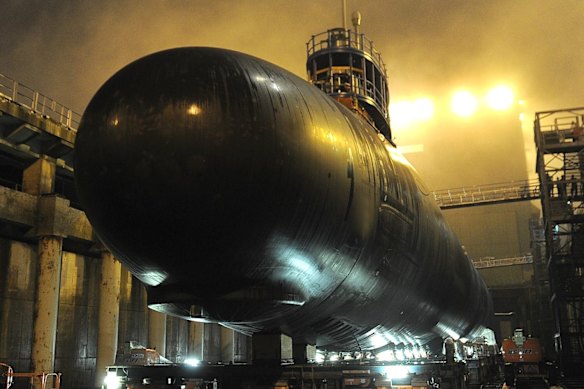
The USS North Dakota, a Virginia-class submarine of the type Australia would acquire under the AUKUS deal.
In briefings with reporters, the Pentagon expressed concerns about whether the US was producing enough nuclear-powered submarines to spare three for Australia, and said Canberra had not given sufficient clarity about how it would use the boats – particularly in a conflict with China.
Those concerns were partially neutered when US President Donald Trump fully endorsed AUKUS during Prime Minister Anthony Albanese’s visit to Washington in October. Trump declared the deal was “full steam ahead”, and should be expedited where possible.
Pentagon Spokesman Sean Parnell said the review was designed to strengthen AUKUS and ensure its long-term success, in alignment with Trump’s “America First” agenda.
“Consistent with President Trump’s guidance that AUKUS should move ‘full steam ahead’, the review identified opportunities to put AUKUS on the strongest possible footing,” he said.
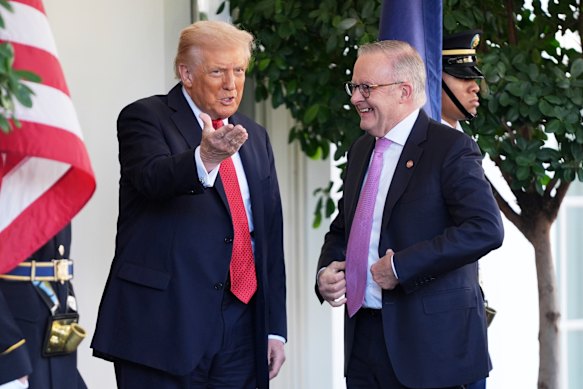
Donald Trump and Anthony Albanese at the White House in October.Credit: AP
However, in the Albanese meeting, US Navy Secretary John Phelan declared there was still “ambiguity” about elements of the deal, though he did not detail them.
While in Washington, Albanese also acknowledged there were parts of AUKUS that would change, but said he wasn’t going to discuss them publicly at that time.
Marles yesterday confirmed the Australian government had received the Pentagon’s AUKUS review and was working through its contents.
Marles and Wong are due to meet with War Secretary Pete Hegseth and Secretary of State Marco Rubio on Monday, US time, for annual US-Australia talks known as AUSMIN.
Sophia Gaston, a foreign policy analyst and AUKUS expert at King’s College in London, said the Trump administration’s approach to AUKUS reflected its broader instinct on alliances.
“It’s about creating a mutually reinforcing uplift to national capability and competitiveness,” she said. “The review’s conclusion will unleash a new narrative that modernises the pact with a stronger emphasis on pace and delivery.
“The question is the extent to which all three governments are willing to pull the levers to deliver ‘AUKUS full fat’ rather than just ‘AUKUS lite’.”
Pentagon review flags ‘critical’ AUKUS deadlines ahead of key meeting


